Mostrando entradas con la etiqueta Filipinas. Mostrar todas las entradas

24/5/20

Virtual Sketchwalks with USK Manila

"Virtual Encounters" to draw from a point in Google Street View in Phillipines arranged by Usk Manila during the world confinement situation since Covid-19, in April and May .

Burnham Park. Baguio
Quiapo Church (Manila) from Quezon Boulevard
Tutuban Center from Recto Ave. One of the busiest areas in Manila 
 Rizal Shrine, Calamba, Laguna
Zamboanga City Hall
Church of Our Lady of Guadalupe in Valladolid, Negros Occidental. 
 Fuerte de San Pedro , military defense structure, in Cebu
More of my posts about Phillipines.

14/5/20

Virtual Sketchwalk in Valladolid Phillipines


During the world confinement situation since Covid-19, some very interesting artistic initiatives have emerged. Among the people we usually meet to draw, the idea of “virtual meetings” came up.
In coordination between the groups USK Manila (Philippines) and Valladolid Dibuja (Spain), we jointly organized and coordinated some "Virtual Encounters" to draw from a point in Google Street View.
After completing the work, we shared it on social networks.
On May 9, the virtual sketchwalk was held in Valladolid, Negros Occidental. An opportunity to "travel" and get to know this
beautiful place in the Philippines.
The meeting was a success, we were more than 70 participants with more than 80 works. Mabuhay!


Durante la situación  mundial de confinamiento a  partir del Covid-19, han surgido algunas muy interesantes iniciativas artísticas. Entre la gente que quedábamos habitualmente para dibujar, surgió la idea de las “quedadas virtuales”.
En coordinación entre los grupos USK Manila ( Filipinas) y Valladolid Dibuja (España), organizamos y coordinamos conjuntamente unos “Encuentros Virtuales” para dibujar a partir de un punto en Google Street View.
Tras realizar los trabajos los compartimos en las redes.
El 9 de Mayo, el encuentro virtual se hizo en Valladolid, Negros Occidental. Una oportunidad para “viajar” y conocer este bello lugar de Filipinas.
El encuentro fue todo un éxito, fuimos más de 70 participantes con más de 80 trabajos.


More of my posts about Phillipines.

24/3/20

Matictic river

In Norzagaray, Bulacan, there are hardly any bars or other places for recreation. However I discovered a beautiful place by the river Matictic with barbecues and long bamboo tables where families and groups of friends make their meetings, and children go swimming.
I used to take my son to this place every day. I liked to paint the children playing in the water and swimming in the river.
Just two months ago I was taking these sketches on Matictic.We were not aware then of how the world was changing in those days because of the coronavirus. Now, when I write this post from my confinement in Spain, Matictic seems to me a distant and beautiful dream.


More of my posts about Phillipines.

8/3/20

Sketchwalk in Manila

January 18th. My first Sketch meetup of the year, a great chance to remeeting Muf and to meet some of the rest of my dear Usk Manila group to which I belong since 2016; Ched, Gee, Ethel, …,. The appointment was close to the Gomburza Monument, along Padre Burgos ave., in front of the National Museum. We were drawing there until 4 p.m. This was the result.


My post about January 2017 Sketchwalk.

More posts about Phillipines.

5/2/20

Vigan Empanada

Vigan is the Philippine’s most extensive and only surviving historic city that dates back to the 16th century Spanish colonial period. But not only in architecture, Spanish heritage is also present in its cuisine. Best known Vigan cuisine  is empanada and longganisa.
Vigan Empanada is  fried to a crisp, with vegetable and meat filling. Rice flour is used for making the crust or the shell. The galapong or rice flour dough is made a day before it is used. Atchuete or orange food color, salt and oil are mixed into the rice though. The dough mixture is then kneaded as thinly as possible on a banana leaf .
Filling is made up of green papaya that is grated, toge or mung bean sprouts, monggo or mung bean and shredded carrots, one whole egg and skinless Vigan longganisa.

Vigan, declarada Patrimonio de la Humanidad por la UNESCO, es el lugar de Filipinas donde mejor ha perdurado el legado español, la ciudad tiene el casco histórico más extenso y único del país que se remonta al período colonial español del siglo XVI. Además la herencia española está presente en su gastronomía, siendo sus platos típicos la empanada y las longanizas 
La empanada de Vigan tiene su origen y es de aspecto y elaboración similar a las empanadillas españolas. La masa de harina de arroz o galapong se prepara un día antes. Antes de freir, el atchuete, que dará su color anaranjado a la empanada, la sal y el aceite se mezclan con el arroz y se amasa lo más finamente posible sobre una hoja de plátano. El relleno lleva papaya verde rallada, brotes de frijol mungo o munggo, monggo o frijol mungo y zanahorias ralladas. Se añade un huevo entero y longaniza sin piel. Se dobla y cierra la masa en forma de media luna y se frie en aceite hasta quedar crujiente y se escurre. Se acompaña de vinagre con cebolla.

More posts about Food in this Blog.
More posts about Phillipines. 

Quiero mencionar y dedicar este post a Manuel Ruiz, escritor y crítico gastronómico gaditano que investigó esas recetas de ida y vuelta con Filipinas y a la chef Paloma Arranz pionera en dar a conocer en Valladolid la cocina filipina.

4/2/20

Scenes of Norzagaray

Life is quiet in Norzagaray. The population of this beautiful municipality of Bulacan, near Sierra Madre and fed by the Angat river, is especially welcoming and curious with me. They are not used to seeing foreigners around here. So when I take out the notebook and start drawing on the street, it is a great event for them that breaks with their serene everyday life. I love crossing the Matictic bridge, strolling through the streets between the bustle of tricycles at the time of school leaving, the smell of barbecues at food stalls, the color of fish and fruit stalls, ...


La vida es tranquila en Norzagaray. La población de esta bella municipalidad de Bulacan, próxima a Sierra Madre y bañada por el rio Angat, es especialmente acogedora y curiosa conmigo. No están acostumbrados a ver extranjeros por aquí. Así que cuando saco el cuaderno de apuntes y me pongo a dibujar en la calle es para ellos gran acontecimiento que rompe con su serena cotidianeidad. Me encanta cruzar el puente de Matictic, pasear por las calles entre el bullicio de los tricicles a la hora de la salida de los colegios, el olor de las barbacoas en los puestos de comida, el colorido de los puestos de pescado y frutas, …

2/2/20

Estrellita Luna

Fragment of the portrait made for my mother in law recently deceased Estrellita Luna, in 2012, Watercolor on 21x29 cm. 160g. Canson paper. inspired by the picture by the philippine painter Juan Luna, "Bulakenya".
La Bulaqueña, literally  "the Bulacan woman", also sometimes referred to as Una Bulaqueña ("a woman from Bulacan"), is the Spanish title of an 1895 painting by Filipino painter and hero Juan Novicio Luna. Bulacan is a province in the Philippines in Luzon island and its residents are called Bulaqueños, also spelled as Bulakenyos ( Bulakenya for women) in the Filipino language. It is a "serene portrait", of a Filipino woman wearing a Maria Clara gown, a traditional Filipino dress that is composed of four pieces, namely the camisa, the saya (long skirt), the panuelo (neck cover), and the tapis (knee-length overskirt). The name of the dress is an eponym to Maria Clara, the mestiza heroine of Filipino hero José Rizal's novel. The woman's clothing in the painting is the reason why the masterpiece is alternately referred to as Maria Clara. It is one of the few canvases done by Luna illustrating Filipino culture.
The original painting by Luna has been recently restored and can be visited in National Museum in Manila.

10/2/18

Chinese New Year and the concept Chinatown

Next February 16 will be the Chinese New Year, (this year will be the dog's). It's been a year since I was in Thailand celebrating the Chinese New Year; It's 3 days of celebration in that country, in the Philippines, where I could live the preparations for these events, it's also festive.
Since China is since the nineteenth century the country that has contributed the most migrants to the rest of the world, there are important Chinese communities scattered around the planet. These preserve many of their traditions, gastronomy, celebrations, ...
Chinese Garden. Manila. Philippines

The word Chinatown 唐人街denominates a zone of the city where a great amount of population of Chinese origin resides within a non-Chinese society. There are Chinatowns in almost every major city in the world
China town. Bangkok. Tailand
I conclude the post with a sketch I took in  Havana´s Chinatown. This Chinatown became the most important in America. Today, most Cuban Chinese are mixed with Spaniards and Africans.
China Town. La Habana. Cuba
El próximo 16 de Febrero será el año nuevo chino, (este año será el del perro). Hace ahora un año que estuve en Tailandia en la celebración del año nuevo chino; son 3 días de fiesta en ese país, en Filipinas, donde pude vivir las  preparaciones para estos eventos, es también festivo.
Ya que China es desde el siglo XIX el país que más emigrantes ha aportado al resto del mundo, hay importantes comunidades chinas repartidas por todo el planeta. Estas conservan muchas de sus tradiciones, gastronomía, celebraciones,…El término Chinatown 唐人街 denomina una zona de la ciudad donde reside una gran cantidad de población de origen chino dentro de una sociedad no china. Hay barrios chinos en casi todas las grandes ciudades del mundo. Concluyo el post con un apunte que tomé en el barrio Chino de La Habana. Este llegó a ser el  más importante de América. Hoy en día la mayoría de los chinos cubanos son mezcla con españoles y africanos.

19/3/17

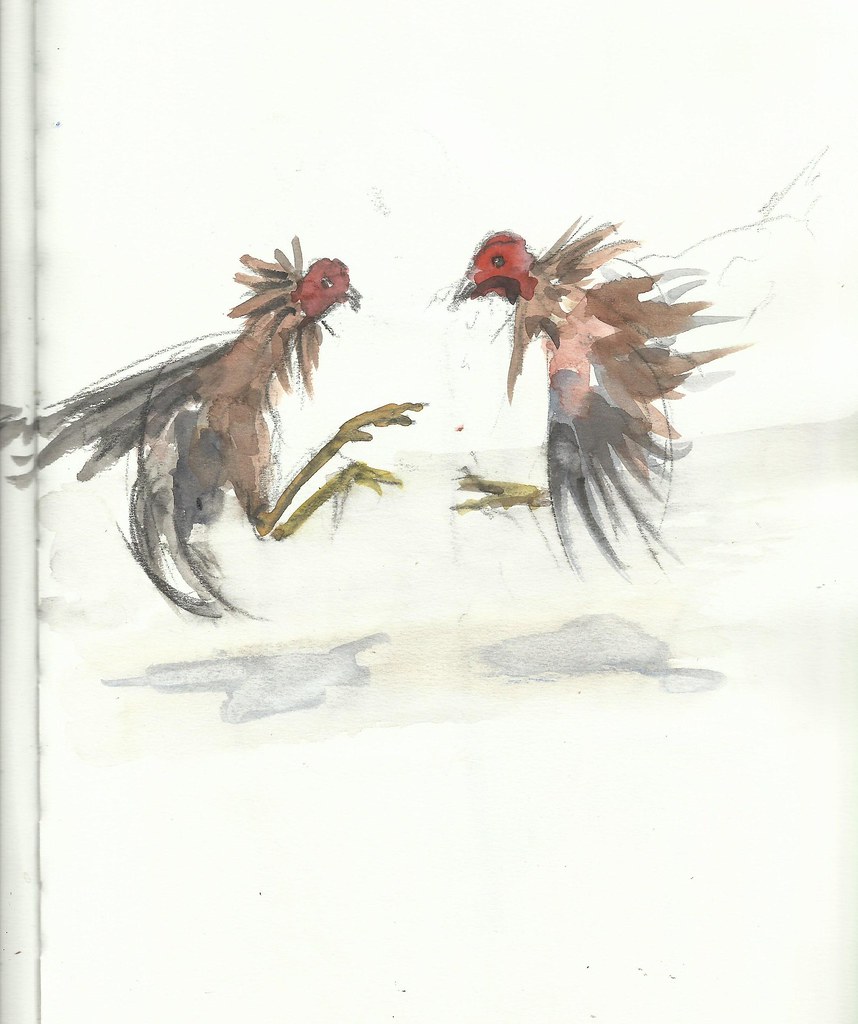
Sabong. Sketching the cockfight

During my stay in the Philippines I didn´t miss the opportunity that I found to portray and report about cockfights. Cockfighting or Sabong is undoubtedly one of the most atavistic and rooted traditions in the Philippines. 
Performing the report among the crowds in the cockfight was a challenge for me. When I began to draw on my notebook I felt the unusual and embarrassing situation, more for the host who accompanied me. Fortunately, however, the initial shame did not overwhelm my desire to draw and finally I think that I became part of the spectacle that afternoon in the cockpit arena.
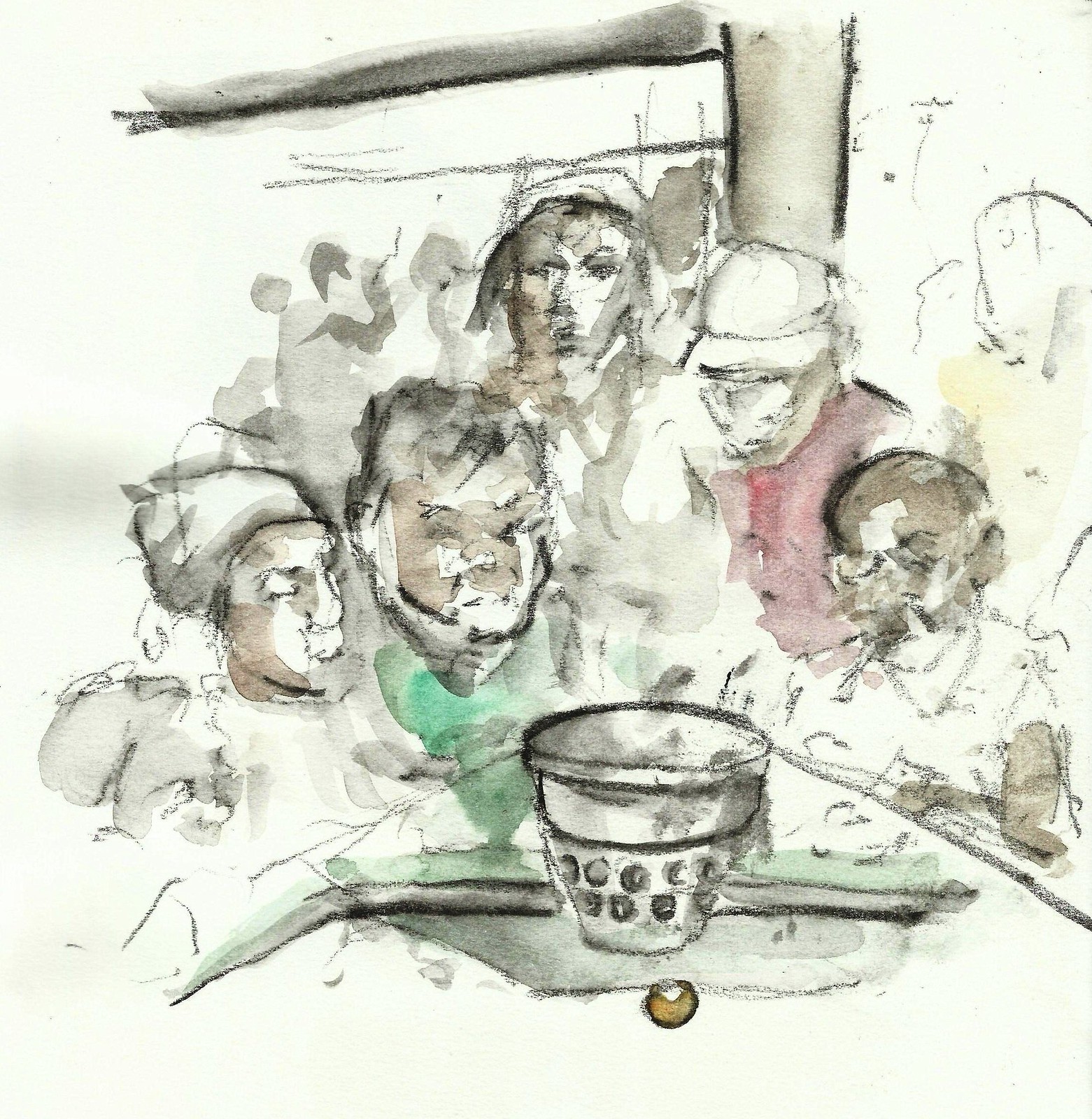
Sa pula sa puti. Norzagaray Arena
Filipinos love to bet. When we arrived at the coliseum, the fights had not started however there was a group of men playing “sa pula sa puti” around a board, betting the color of the box on which the ball would be placed. This was the first sketch of the afternoon.
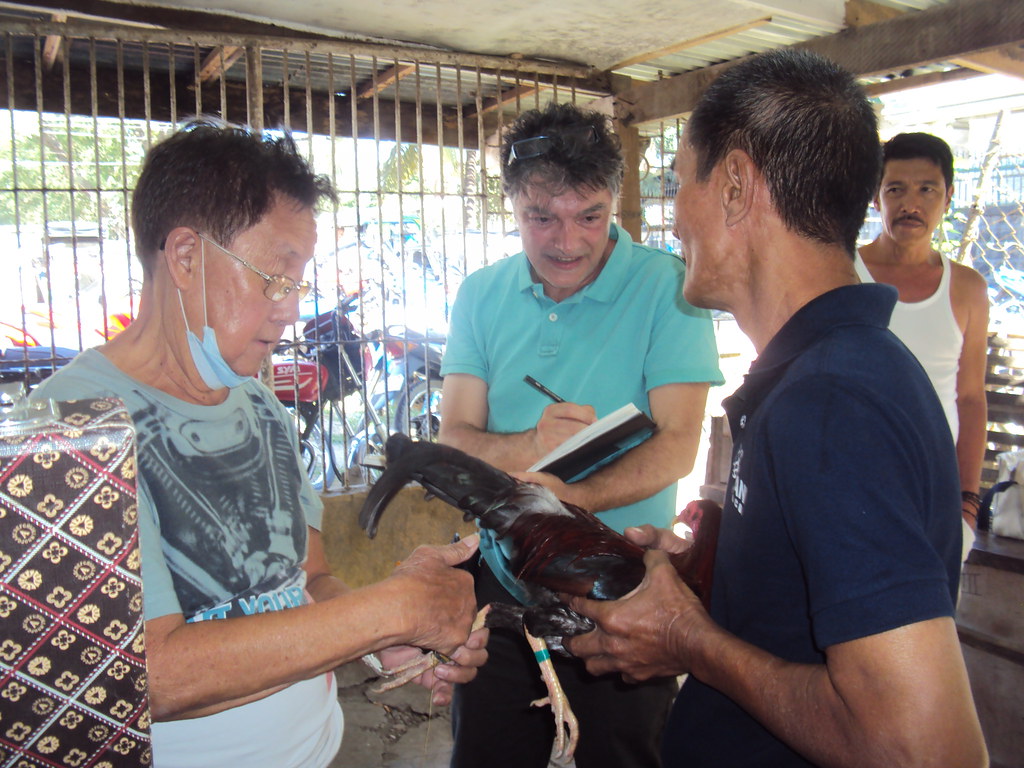
After this, I was allowed to go into the room for fight preparation. The Manari, often a trusted person of the owner, determines the fitting length and form of the steel spores. He should have at least eight knives. If he does not attach the spores, this is the task of the Heeler (blade fixer). This task must be carried out very careful and it is crucial for the fight.
The Manari and the Heeler
Sketch , Watercolor,  on 21x29.7 cm.160 gr. Fabriano drawing paper
Before the combat, the cocks´ fighting spirit gets stimulated by bringing them together, so that they go in feint attacks. This gives an impression to the audience, which cock will be the favourite. Later the referee takes off the leather wrappers, examines the knives and wipes them again with alcohol in order to exclude the use of laming poisons. If he gets the impression that the bet businesses are finished, he gives the sign for the beginning of fight.
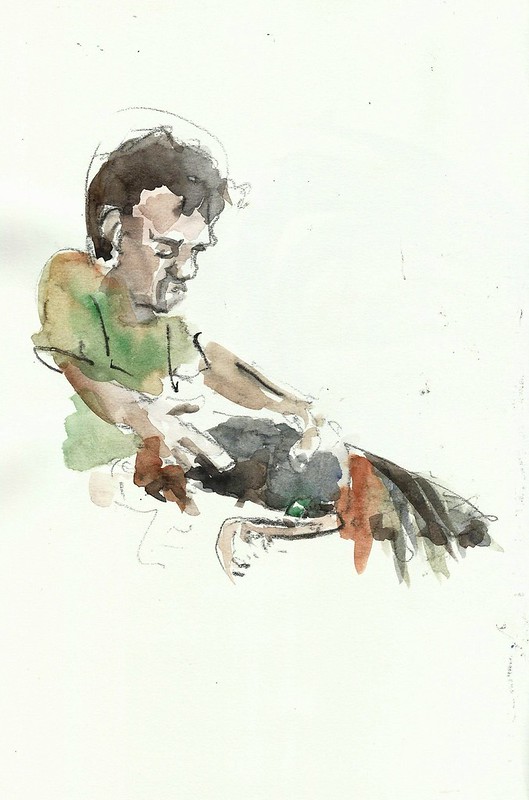
The Cock Doctor Watercolor,  on 21x29.7 cm.160 gr. paper
The wounds of the victorious cock are sutured up behind the bleacher, if there is a chance of convalescence and the owner gets the bet shares of the central bet. From this sum, he still has to pay the handler, the blade fixer, the organizer as well as other bet participants.
The Cock doctor was delighted with my sketch and took some pictures of my works.
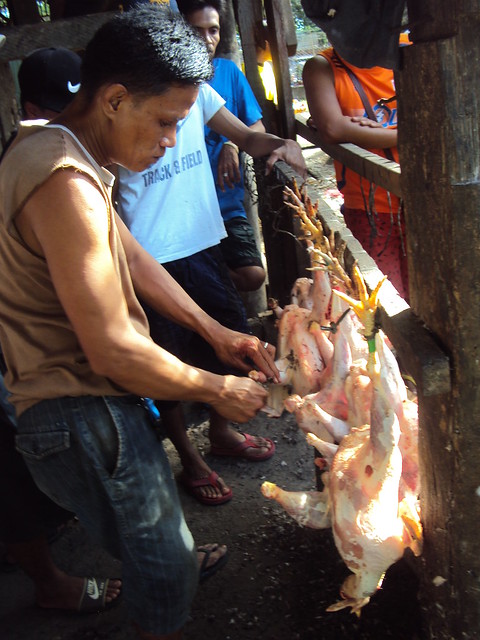
The losing cock, dead and inferior, is mostly handed over to the winner as a trophy for consumption.

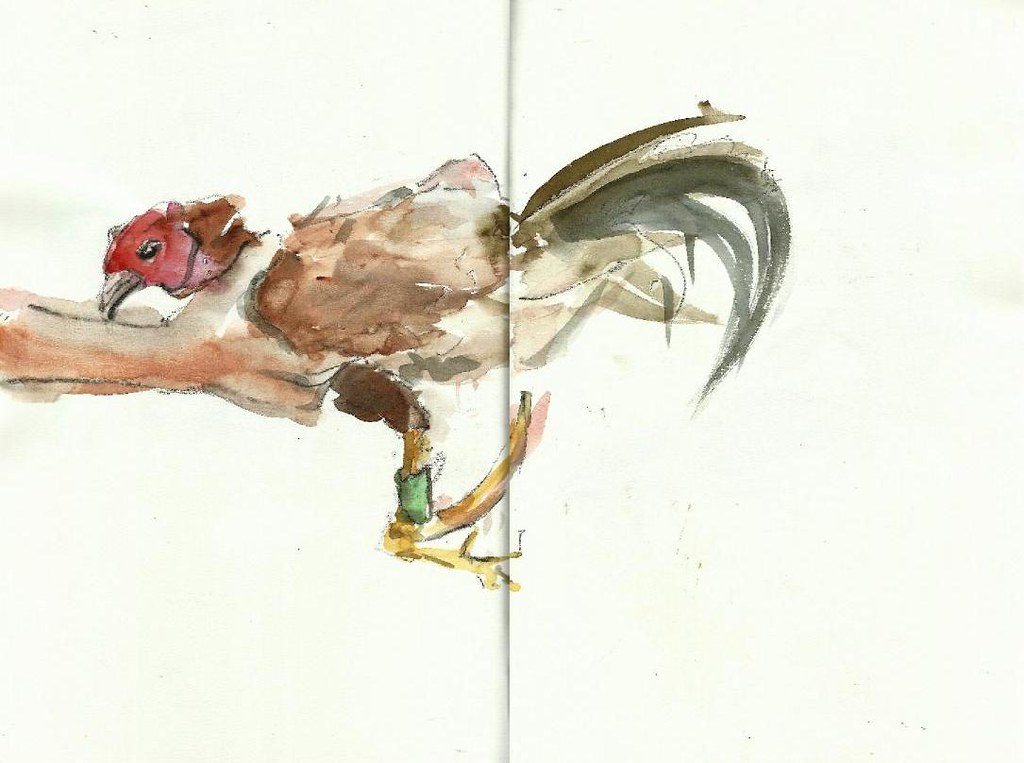
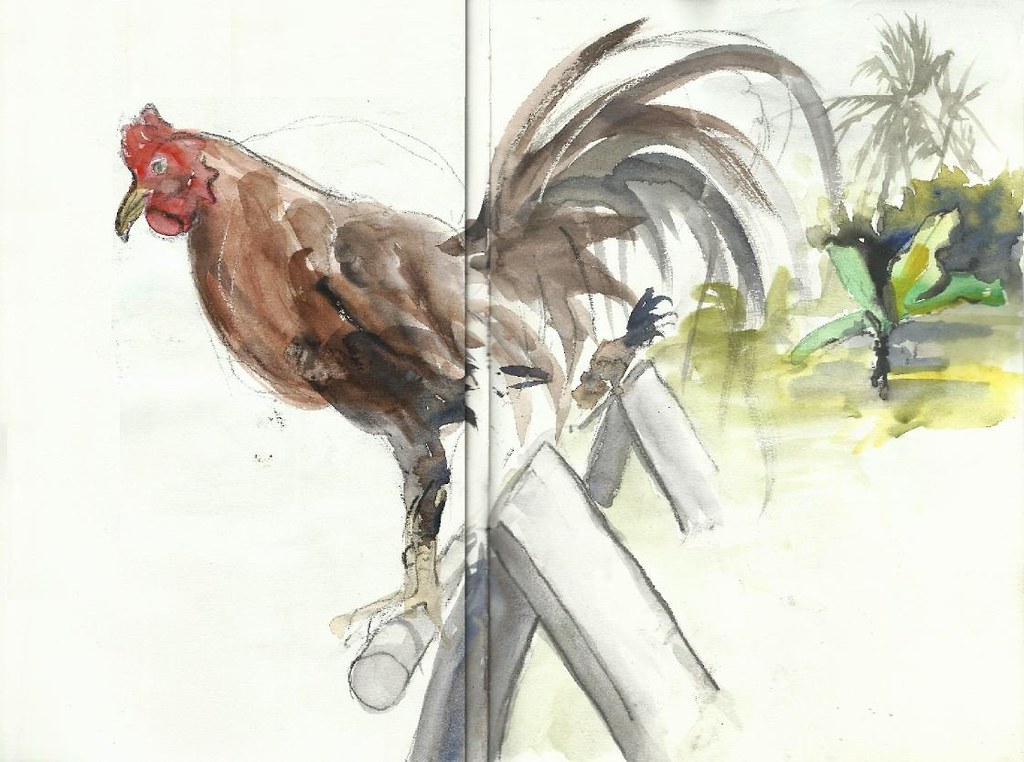
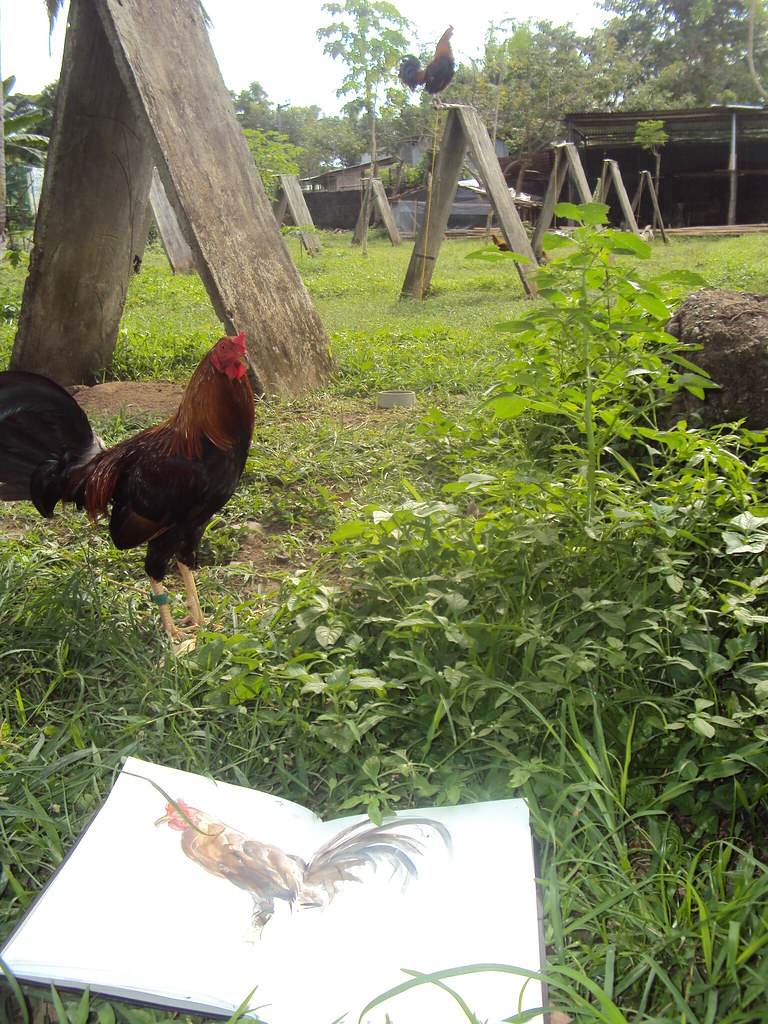
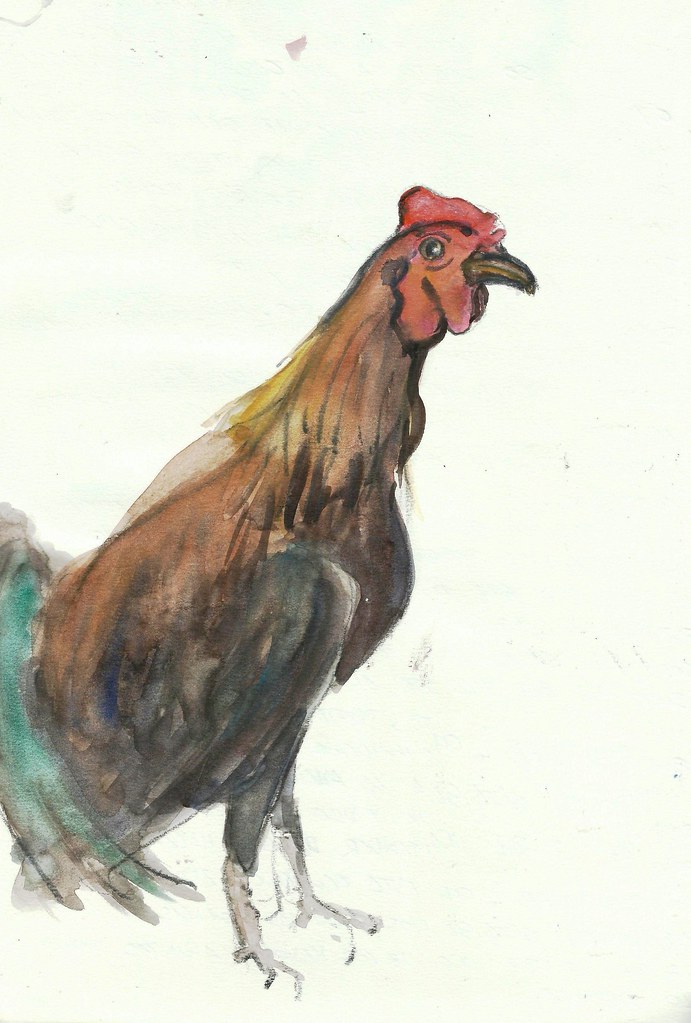
To the report, I add the sketches that I took a few days before in a breeding ground for fighting cocks.


Durante mi estancia en Filipinas no desaproveché la oportunidad que se me brindó para conocer y retratar las peleas de gallos. Estas son sin duda una de las tradiciones más atávicas y arraigadas en Filipinas. Realizar el reportaje entre la multitud en el reñidero de gallos fue todo un desafío para mí. Cuando comencé a dibujar sobre mi cuaderno sentí lo inusual y embarazoso de la situación, más para el anfitrión que me acompañaba. Sin embargo, afortunadamente, el pudor inicial no se impuso a mis ganas de dibujar y finalmente creo que esa tarde en la pelea yo fui parte del espectáculo.
A los filipinos les encanta apostar. Cuando llegamos al coliseo, las peleas no habían comenzado, sin embargo había  un grupo  de hombres en torno a un tablero apostando el color de la casilla sobre la que se posaría la pelota. Este fue el primer apunte de la tarde.
Tras esto, me dejaron pasar a la sala donde les fijan las cuchillas a los gallos. El Manari, a menudo una persona de confianza del propietario, determina la longitud apropiada y la forma de las cuchillas de acero. Debería tener al menos ocho cuchillos. Si no se adhieren las esporas, esta es la tarea del Heeler (fijador de cuchilla). Esta tarea debe llevarse a cabo con mucho cuidado y es crucial para la lucha.
Antes del combate el espíritu combativo de los gallos se estimula  encarándolos. Esto da una impresión a la audiencia de cual gallo es el favorito. Más tarde el árbitro quita las envolturas de cuero, examina los cuchillos y los limpia de nuevo con alcohol para excluir el uso de venenos. Cuando tiene la impresión de que las apuestas están  hechas, da la señal para el comienzo de la pelea. La peleas no suelen durar más de un par de minutos. El propietario recibe las acciones de apuesta de la apuesta central. A partir de esta suma que todavía tiene que pagar al manejador, al fijador de la hoja, al organizador, así como a otros participantes de la apuesta. El gallo perdedor, muerto y desplumado, es entregado al ganador para el consumo.Tras el combate, el "Cock doctor" , tras las gradas, tratará de suturar las heridas de los gallos vencedores. El veterinario de esa tarde quedó encantado con mis dibujos y me pidió posar con él.
Al reportaje quiero añadir los apuntes que hice unos días antes en un criadero de gallos de pelea.
21x29.7 cm.160 gr. Fabriano drawing paper.Sketchbook.

13/3/17

Walis tingting

Sketch on 21x29.7 cm.160 gr. Fabriano drawing paper.
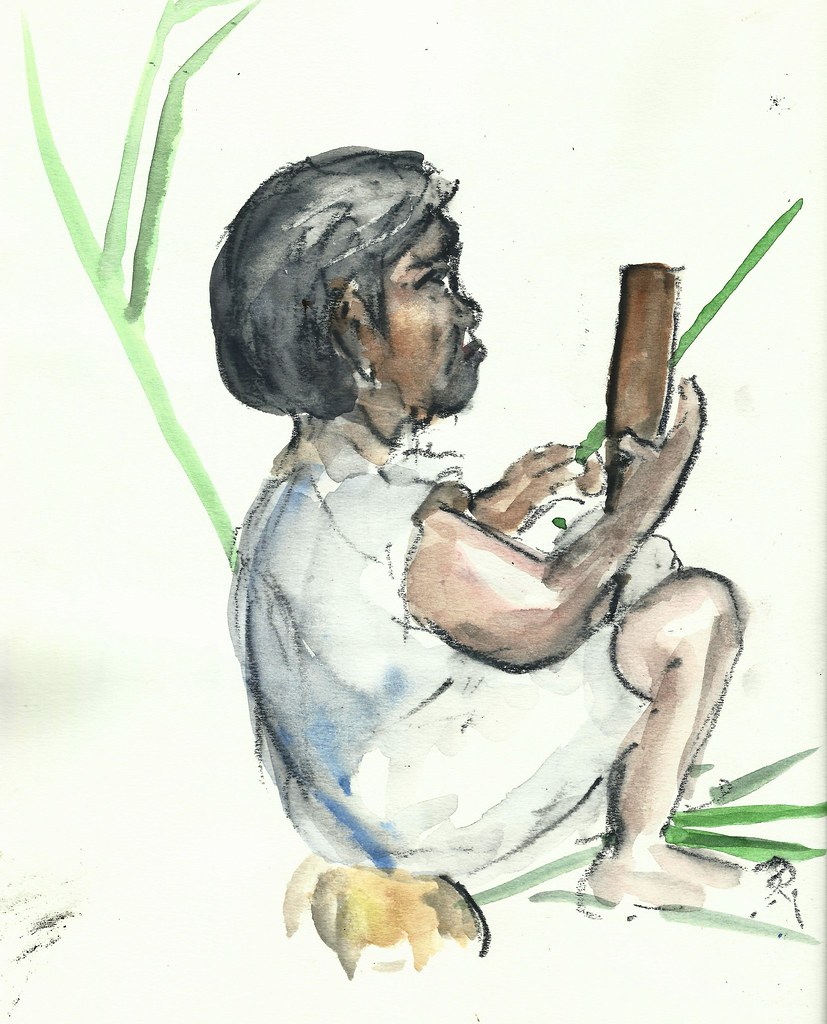
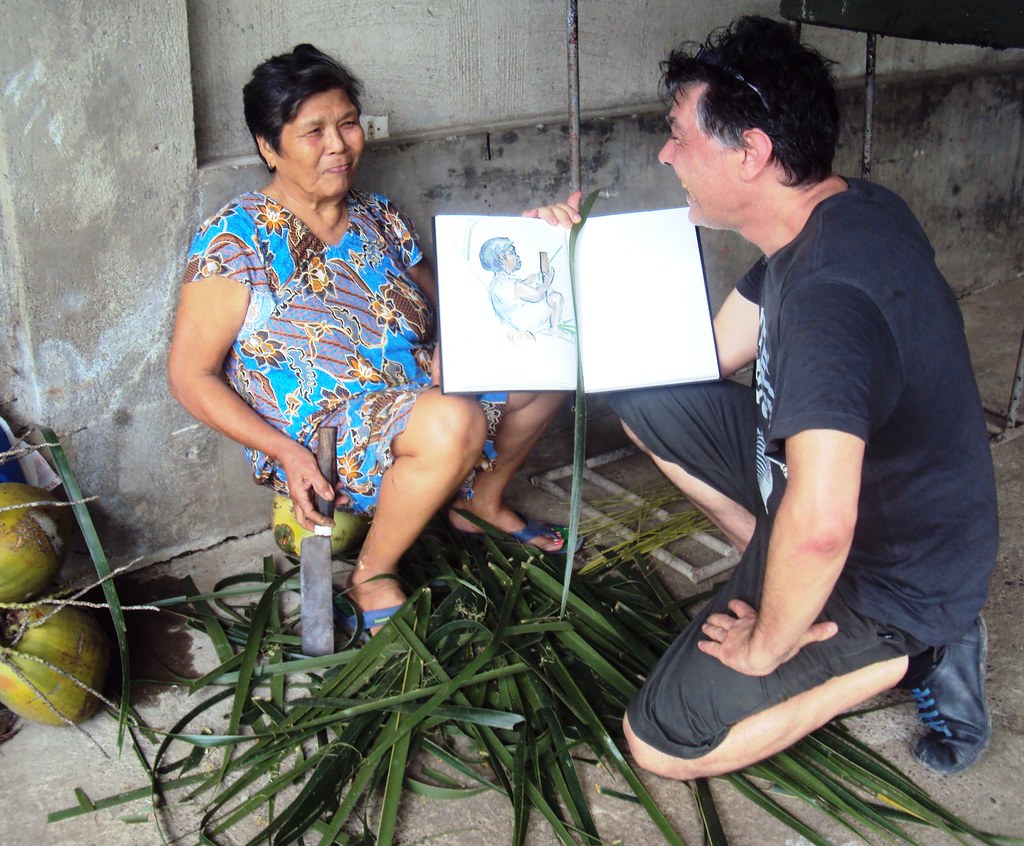
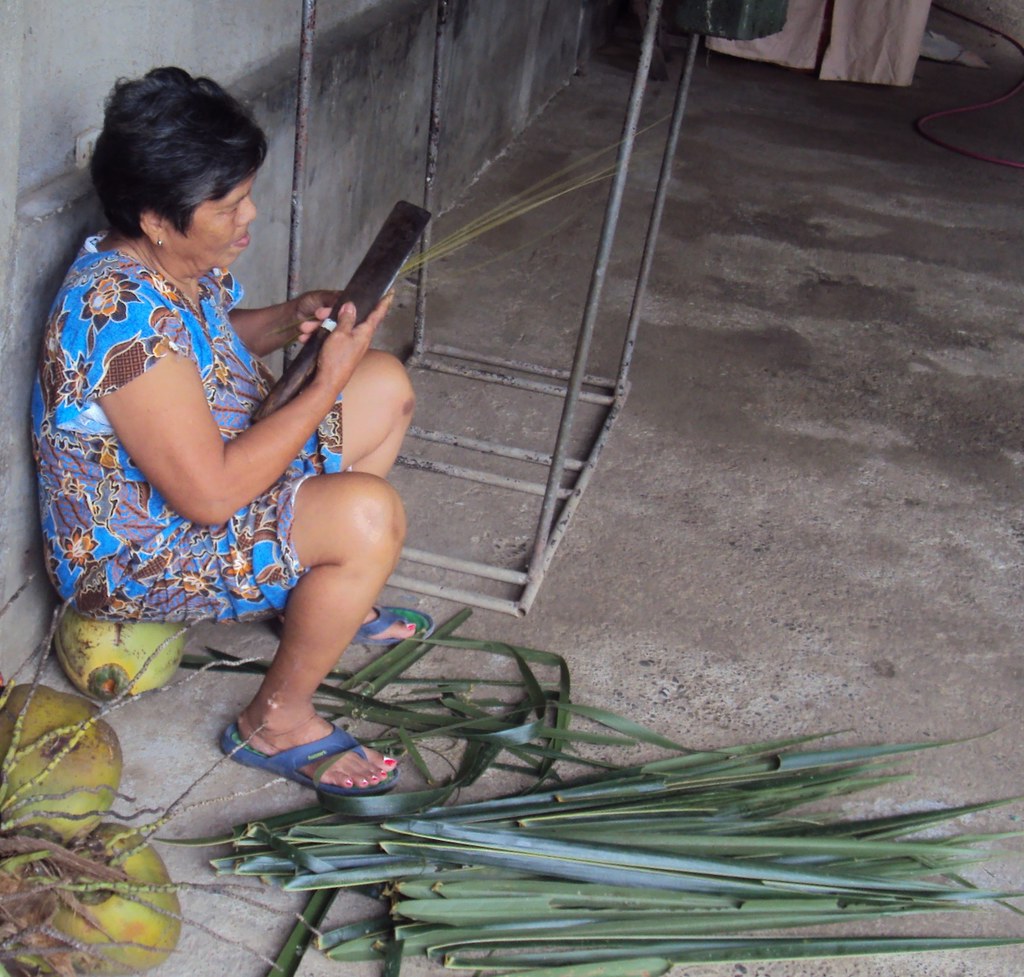
One afternoon I had the opportunity to portray a friend of my mother-in-law, Mrs. Mendoza, making a walis ting-ting (broomstick made from the ribs of coconut leaves). A great ethnographic  showing.
Using a knife, Sitting on top of some coconuts, amongst a pile of coconut leaves, stripping the green or yellow leaves from the central rib and setting aside hundreds of ribs to be grouped together into a broom.
A walis ting-ting is the Tagalog word for broomstick made from the ribs of coconut leaves, massed together to make a uniquely strong broom with needle like bristles, but incredibly pliable at the same time. The word "walis" meaning broom, and ting-ting which is the midribs of the coconut leaves used to create the broomstick.
To make the walis ting-ting, we need a knife, coconut midribs and a tie.
It´s necesary to spend some time scraping off the midribs from the coconut leaves to gather enough of it for the broom.
Set aside all the gathered midribs and when have enough, tie it all together and you would have a homemade broomstick. Cut from the soft ends for the broom to work well.
Una tarde tuve la oportunidad de retratar a una amiga de mi suegra, la señora Mendoza, haciendo un walis ting-ting (palo de escoba hecho de las costillas de hojas de coco). Una gran demostración etnográfica, de una labor que ya casi está en desuso aunque se conozca por muchos filipinos. 
Usando un machete, sentada encima de algunos cocos, entre un montón de hojas de coco, pelando las hojas verdes o amarillas de la costilla central y dejando a un lado cientos de varillas para agrupar en la escoba.
Un walis ting-ting es la palabra en tagalo para la escoba hecha de las nervaduras de las hojas de coco, se agrupan juntas para hacer una escoba, única por sus agujas fuertes como cerdas, pero increíblemente flexibles al mismo tiempo. La palabra "walis" significa escoba, y ting-ting,  es la nervadura central de las hojas de coco, utilizadas para fabricar la escoba.
Para hacer el walis ting-ting,  se necesita un cuchillo, nervios centrales de la hoja de coco y una cuerda.
Es necesario pasar algún tiempo raspando las nervaduras centrales de las hojas de coco para recoger suficientes varillas para la escoba. Cuando hay suficientes, atarlas todas juntas y cortar los extremos blandos para que la escoba funcione bien.
Sobre el tema interesante este link. 


.